
‘I am the light of the world; anyone who follows me will not be walking in the dark; he will have the light of life.’ – John 8.12
‘I am the Way, the Truth and the Life. No one can come to the Father except through me.’ – John 14.6
Welcome to the Fellowship
Welcome to my blog. Through the inspiration of Holy Scripture and the power of the Holy Spirit, my aim is to reveal the life, mission and atoning death of Jesus Christ. The blog is conservative in ethos. The daily readings are drawn from my own selection.
Colin Markham, Hythe, Kent, England.
Unless otherwise indicated Scripture quotations are taken from the Jerusalem Bible. Copyright 1966, 1967 and 1968 by Darton, Longman & Todd Ltd. and Doubleday & Company Inc. FSP quotations from the Jerusalem Bible render ‘Yahweh’ as ‘Lord’, by kind permission of the publisher.
Scripture quotations marked ‘NIV’ are taken from the Holy Bible, New International Version (Anglicised edition). Copyright, 1979, 1984, 2011 by Biblica Inc. Used with permission. All rights reserved worldwide. ‘NIV’ is a registered trademark of Biblica Inc. UK trademark number 1448790.
*** Recommended websites for current affairs and Bible prophecy ***
Dr. Steve Turley on YouTube (USA) – conservative libertarian
LifeSite News (Canada) – traditionalist Roman Catholic
Michael Matt on Remnant TV (USA) – traditionalist Roman Catholic
The James Delingpole Channel (UK) – conservative libertarian
Simon Webb on History Debunked (UK) – putting the record straight
New Culture Forum (UK) – conservative analysis of culture and politics
Moriel TV (UK) – global events in relation to Biblical prophecy
Neil Oliver’s World (UK) – history, society and culture dissected
UnHerd (UK) – alternative voice on politics and culture
John Haller on Fellowship Bible Chapel (USA) – Biblical prophecy
Together Declaration (UK) – fundamental rights and freedoms
Turning Point UK – traditional values and personal responsibility
British Friends of Israel (UK) – solidarity with British Jews
Free Speech Union (UK) – defending the right to free speech
_________________________________________________________
Third Week in Lent
Heal me, Lord, and I shall be really healed, save me and I shall be saved, for you alone are my hope. – Jeremiah 17.14
The spiritual life
‘A blessing on the man who puts his trust in the Lord, with the Lord for his hope.’ – Jeremiah 17.7
Read: Jeremiah 17.5-18
Let us lean on the unshakable rock which is Christ, as Scripture says, “He has settled my feet on rock and steadied my steps” (Ps 40.2). Once we are settled and fortified we will see what he tells us and how we will respond to the things for which he reproaches us.
In many things we all offend him; our lack of simplicity clashes with the rectitude of his will, and this prevents us from attaching ourselves to him. Therefore, we must humble ourselves by saying: “Heal me, Lord, and I shall really be healed, save me and I shall be saved.”
When the eye of our heart is purified by such thoughts, we will no longer consider what God’s will is for us but what his will is in itself. God wills life, and there is nothing more useful or advantageous than to accept his will. That is why we should see to it that the energy we expend in trying to preserve our life be diverted into striving to avoid ever deviating from the path that leads to life.
Then, by following the guidance of the Holy Spirit who scrutinises the very depths of God (1 Cor 2.10), we should reflect on how kind the Lord is and how good in himself. We should ask with the Prophet to see the will of the Lord, and ask him to make us visit no longer our heart but his temple (Ps 27.4).
These two points summarise the content of the entire spiritual life: at the sight of ourselves we are troubled and contrite for our salvation, while in the contemplation of God we are at peace and the joy of the Holy Spirit consoles us. On one side, fear and humility; on the other, hope and love.
St. Bernard of Clairvaux, 1090-1153
‘Thus, as the Father raises the dead and gives them life, so the Son gives life to anyone he chooses; for the Father judges no one; he has entrusted all judgement to the Son, so that all may honour the Son as they honour the Father.’ – John 5.21-22
_________________________________________________________
Daily readings for Week 11
Third Sunday in Lent: 8th March:
Jeremiah 17.5-18 / Psalm 40.1-5 / Luke 18.1-14
Monday 9th March:
Hebrews 2.1-9 / Psalm 32.1-7 / Luke 19.1-10
Tuesday 10th March:
Hebrews 2.10-13 / Psalm 22.22-26 / Luke 19.11-27
Wednesday 11th March:
Hebrews 2.14-18 / Psalm 106.1-5 / Mark 10.17-27
Thursday 12th March:
Hebrews 4.12-16 / Psalm 34.9-14 / Mark 10.28-34
Friday 13th March:
Hebrews 13.1-6 / Psalm 57.7-11 / Matthew 18.1-14
Saturday 14th March:
Hebrews 13.7-19 / Psalm 119.1-8 / Matthew 18.15-35
The word of God and Christ the Word
The word of God is something alive and active: it cuts like any double-edged sword but more finely: it can slip through the place where the soul is divided from the spirit, or joints from marrow; it can judge the secret emotions and thoughts. No created thing can hide from him; everything is uncovered and open to the eyes of the one to whom we must give account of ourselves. – Hebrews 4.12-13
Read: Hebrews 4.12-16
“The word of God is like a double-edged sword.” It separates good and evil in our souls: makes clear the difference between principle and mere carnal desire; and between good and evil thoughts within the same person. As we read elsewhere in the gospel, the Word of God separates people from one another, even among family members, depending on whether they accept or reject the Word of God. God’s word is not hard or cruel or intended to cause pain – just the opposite, it has all the qualities of truth insofar as it is in accordance with principle and serves as a fundamental doctrine and motivating force.
Many people do not realise how important it is to accept and abide by God’s word. That is the reason why we often compromise with the truth, thereby abandoning Christ, who is the Word of God. Christ understands our human dilemmas; he knows our weaknesses; he sympathises with our difficulties. Still, he calls us to live by his truth. And that very truth, further strengthened by grace, provides us with the means to remain faithful.
John A. Marshall, 1928-1994. Bishop of Springfied, Mass., 1992-94.
‘It is for judgement that I have come into this world, so that those without sight may see and those with sight turn blind.’ – John 9.39
___________________________________________________
The purpose of the Fellowship of St. Peter is to promote Christian faith and spirituality.
The central focus is on the person and work of
Jesus Christ.
Christianity in the modern world
As the number of churchgoers dwindle in the western world, Bible-believing Christians need to overcome their differences and consider a form of unity that recognises their common purpose. It’s time for the faithful remnant to act as a creative minority and voice a unified response. In an atmosphere that is increasingly hostile to Christianity, the goal must be to preserve the orthodoxy of the faith in the face of continuing erosion of religious liberty.
The Fellowship extends a hand of friendship to those who have withdrawn from churches which have aligned themselves with secularism and liberal values, thus fatally compromising the integrity of a faith that is essentially counter-cultural.
We must read the signs of the times. The era is drawing to a close. It is time to stand up and be counted as the people of God. Do not be afraid. The gathering darkness will not enshroud the light of faith nor quench the flame of truth. These will remain, along with all those whose steadfast faith shields them in the coming storm.
And Jesus said, ‘behold, I am with you always, to the end of the age.’ (Matthew 28.20).
The word of God
The word of God is a powerful force for enlightenment, a necessary counterweight to secular humanism. The Fellowship seeks to recapture something of the simplicity and vitality of the church in apostolic times, before the purity of the Christian message was corrupted by spurious doctrines. The emphasis is on spirituality that supports the life and ministry of Christians everywhere who believe in the power and dynamism of the word of God.
The Bible speaks to the world. All Christians have something of interest and value to share through their witness. The aim of the Fellowship is to promote prayer, Bible study and spiritual reflection which will bear fruit in daily lives. These disciplines can form the basis of a way of life that requires a strategic withdrawal from the mainstream.
Let the word of God fill your hearts and minds, let it guide and inspire you and refresh you like a clear mountain stream. Be still with God in prayer. Be an instrument of his loving purposes, a purveyor of peace, and let your peace rest on all those you encounter. For those in need of compassion and healing, heed their cares and bind their wounds. Live in uprightness and modesty and exercise restraint in your material needs. Guard your tongue, practise discernment, speak only words of counsel and encouragement, the words of Christ.
Your eyes, hands and impulses should be those of Christ. Pray always for strength and enlightenment. Praise and thank God and place into his care your needs and those of others.
Bible. Prayer. Witness. These are the three principles on which the Fellowship is founded.
By his divine power, he has given us all the things that we need for life and for true devotion, bringing us to know God himself, who has called us by his own glory and goodness. In making these gifts, he has given us the guarantee of something very great and wonderful to come: through them you will be able to share the divine nature and to escape corruption in a world that is sunk in vice. But to attain this, you will have to do your utmost yourselves, adding goodness to the faith that you have, understanding to your goodness, self-control to your understanding, patience to your self-control, true devotion to your patience, kindness towards your fellow men to your devotion, and, to this kindness, love. If you have a generous supply of these, they will not leave you ineffectual or unproductive: they will bring you to a real knowledge of our Lord Jesus Christ. But without them a man is blind or else short-sighted; he has forgotten how his past sins were washed away. Brothers, you have been called and chosen: work all the harder to justify it. If you do all these things there is no danger that you will ever fall away. In this way you will be granted admittance into the eternal kingdom of our Lord and saviour Jesus Christ. (2 Peter 1.3-11).
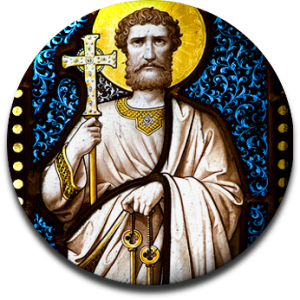
Why Peter?
Peter represents Everyman in all his frailty, vulnerability and confusion. He was headstrong yet inspired, well-meaning but impetuous. His heart was in the right place but he didn’t always live up to his own rhetoric. He triumphed over his weaknesses by the grace of God and saw the perfect vision of Christ and what that vision meant for the church and the world.
Peter was a leading figure during Christ’s walk on earth. He occupied a position of seniority amongst the disciples. He was there at all the major events during Christ’s ministry and in the final days leading up to the crucifixion, resurrection and ascension into heaven. It was to Peter and his fellow apostles that Jesus entrusted the legacy of truth enshrined in his teachings, the keys of the kingdom. After Pentecost Peter and his companions went out to the world to proclaim the Gospel.
Acts of the Apostles. Peter became a leading light in the early days of the church, the apostle to the Jews living in the diaspora. His authority in the nascent Christian community has to be viewed against the ascendancy of Paul as apostle to the Gentiles, a position that gave Paul equal authority in the direction of missionary work.
In terms of Peter’s primacy of leadership, however, “….one should not look in Peter or in the primitive church for the developed conception of the primacy which appears no earlier than the third century. The development of power possessed by the church and by Peter into monarchical leadership lies outside of biblical theology.” (John McKenzie, Dictionary of the Bible)
The Gospel of Mark. The church historian Eusebius (d. ca. 339) wrote: “Mark, who became Peter’s interpreter, wrote accurately, though not in order, all that he remembered of the things said and done by the Lord. For he had neither heard the Lord nor been one of his followers, but afterwards followed Peter, who used to compose his discourses with a view to the needs of his hearers.”
1 and 2 Peter. Of the two letters that bear Peter’s name, the first seeks to encourage and strengthen early Christian communities suffering persecution, reminding them of their heritage. The second has more to do with the dangers of heresy and how Christians can have confidence in the truth of Scripture. These encouragements and warnings resonate with us living in times of moral decline and religious indifference.
Blessed be the God and Father of our Lord Jesus Christ! According to his great mercy, he has caused us to be born again to a living hope through the resurrection of Jesus Christ from the dead, to an inheritance that is imperishable, undefiled, and unfading, kept in heaven for you, who by God’s power are being guarded through faith for a salvation ready to be revealed in the last time.
(1 Peter 1.3-5).
Peter was martyred in Rome during the Neronian persecutions, probably in the year 64.
Jerusalem Cross
There are various interpretations of the symbolism. The four smaller crosses are thought to denote either the four gospels or the way the Gospel spread to the four corners of the earth. In terms of God’s revelation and world history, the city of Jerusalem is of huge political, religious and symbolic importance. The focus is highlighted in the gospels and in the emergence of the first Christian communities described in the Acts of the Apostles. It was from Jerusalem that the apostles scattered to proclaim Christ.
The spiritual life
We must keep the Bible open before us. It is our enlightenment, our source of consolation, our prayer book. It contains the revelation of God’s purposes in salvation history. It is the well-spring of all the truth, goodness and wisdom that God wishes to transmit to human beings who he ordained to administer the complexities of the natural world and to carry forward knowledge of salvation history with its outcome in the incarnation of Christ.
The Lord guides and strengthens us, keeping us firmly rooted in the faith. Throughout all the trials we endure in this troubled world, Christ is with us. The word of God inspires us in various ways, and through the Holy Spirit we gain knowledge, wisdom and discernment, maturing in the faith as citizens of the Kingdom of God.
Remain within the confines of God’s kingdom. Stay on the straight and narrow path that leads to salvation. Do not look with longing towards the sunlit hills at every temptation. Too many have trodden the path to destruction, too many have fallen by the wayside.
The Christian life is about being transformed by Christ, being absorbed by him so that his teachings and his very presence guide our every motivation and action. Christ’s love is mediated through us in the power of the Holy Spirit. We follow the leadings of the Spirit in order to renew and deepen our faith.
There is a wonderful symmetry involved in the divine-human relationship. Christ, the sinless one, is the embodiment of human perfection. Through his very nature as Son of God he brought mankind nearer to the Father. Through Christ, God shared in our humanity and he also made it possible for us to share in his divinity. Christ underwent the ultimate sacrifice to reconcile man to his creator, making it possible for God’s plan of salvation to be brought to completion, inaugurating a New Covenant with mankind. We need to keep before us the astounding truth of his victory over evil on the Cross, through which mankind gained forgiveness and the freedom to live the gospel life infused with selfless love (cf 1 Corinthians 13.1-13).
Christ established a new reality, that to be justified by faith is a sacred identity. We are identified as Christians when we accept and appropriate the fullness of Christ. This requires a heroic response from human beings because it runs counter to human pride, the instinct for autonomy. The response must be underpinned by contrition and humility and it is brought to perfection by obedience. Once we take hold of Christ we become his disciples. Discipleship is a life-long commitment, a transforming friendship with Jesus. (Luke 9.23-26; John 15.14-17).
Christ’s death and resurrection brings to mankind redemption and salvation to eternal life. Christ has opened the way for us to follow him to the perfect vision, far superior to the limitations and imperfections of our earthly existence. To consolidate the New Covenant with man, the Father has sent us the power to sustain us on our journey through the snares and pitfalls of this troubled world. This power is the Holy Spirit (John 14.16, 26). Christ’s presence is manifested in the Holy Spirit. The Spirit reminds us of his teachings, works in our conscience when we fail, grants us perception when we read Holy Scripture, inspires us in our prayers and meditations, whispers to us in our silent spaces, strengthens us in times of adversity and provides us with prophetic speech. The Spirit empowers us in our various ministries and impels us to rise above the banalities and temptations of a world that is hostile to our sacred calling. (Mark 13.5-13; Romans 12.3-9; 1 Corinthians 12.4-11; Ephesians 4.7-13; James 1.16-18, 3.13-18; 1 Peter 3.13-17, 4.7-19).
The worldwide community of faith
Christians across the world have a common purpose: striving to live the Gospel life in the face of both widespread indifference and open hostility to the teachings of Christ. The Christian faith is essentially counter-cultural yet many churches are now aligned with secular humanism, thus inflicting upon themselves the fatal wound of apostasy. The enemy is no longer at the gates, he is within the citadel.
For our Spirit-filled life to succeed we are to distance ourselves from the corrupt influences of modern culture (1 John 2.15-17, 5.18-20). There are to be no half measures, no compromise with evil in any of its forms, no accommodation with other religions. This detachment is crucially important to safeguard the integrity of the Christian faith. These are perilous times. Christianity is under assault from atheistic humanism, the dominant force in social and political culture. Faced with this threat there is to be no weakening on our part. We are to profess the faith and demonstrate in our lives the true destiny of humankind, the freedom to love the Lord our God with all our heart, with all our soul, with all our mind and with all our strength, and to love our neighbour as ourselves. There is no higher ideal for man to attain (cf Mark 12.28-34; Romans 13.8-10).
Discipleship
The Sermon on the Mount (Matthew 5-7) appears to portray Christ as the new Moses, but he far exceeds all the prophets and patriarchs of old by his uniquely divine provenance and his destiny as Saviour of the world. He is not only the promised Messiah, he is also Priest, Prophet and King. His teachings lead us into the Kingdom of God, into a realm of love, creating a priesthood of believers (1 Peter 2.1-10). We yearn for the promised homeland above where our labours will be rewarded by eternal peace (2 Peter 3.8-14).
The Beatitudes (Matthew 5.1-12) are a concise presentation of the Christian ethos, describing the blessed virtues essential to life in the Spirit. They are the supreme ethical and moral guide to Christian life and discipleship, illuminating our path in the human maze. They set out the Christian way of life, lived in response to Christ through faith. We strive to uphold values intrinsic to human dignity, stable family life and the maintenance of social order: humility, gentleness, compassion, justice, peace, integrity, courage and witness. All the blessings of the kingdom are encapsulated in the Beatitudes.
Christ came to fulfil the Law and the Prophets (Matthew 5.17-19). The validity of the Ten Commandments remains (Exodus 20.1-17) and in the Beatitudes Christ describes the spirit in which the Commandments are to be lived out in both church and society. They exemplify Christian discipleship. They are echoes of the divine, revealing Christ in his perfection. They define the inward motivations of integrity and love that characterise discipleship, as well as the blessed rewards of faithful service in Christ’s name. Our acts of charity and mercy spring from a heart filled with selfless love founded on the teachings of Christ and energised by the Holy Spirit.
The teachings of Christ are uncompromisingly radical. They are employed to combat philosophies that erode the dignity of man: consumerism (money and possessions bring happiness); relativism (there is no absolute truth); secularism (a world view without God); existentialism (life has no purpose). In the midst of these evils the Gospel shines like a beacon of truth. And through it all we persevere in the name of Christ, despite the difficulties we encounter on our journey of faith (1 Peter 4.12-19). God will restore, confirm, strengthen and establish us in times of adversity (1 Peter 5.10-11).
Our faith is a wonderful gift to possess and convey to others, and discipleship places on us a sacred responsibility. It is a joy and a holy privilege to walk with Jesus, to be in his loving presence in a life of Christian service (Luke 10.23-24; John 15.1-17; Ephesians 4.7-16).
Further reading
Dale C. Allison
The Sermon on the Mount: inspiring the moral imagination. Herder & Herder, 1999.
Carl E. Braaten and Christopher R. Seitz
I am the Lord your God: Christian reflections on the Ten Commandments. Eerdmans, 2005.
Walter Brueggemann
The Bible makes sense. Westminster John Knox Press, revised edition, 2001.
Rod Dreher
The Benedict option: a strategy for Christians in a post-Christian nation. Sentinel, 2017.
Live not by lies: a manual for Christian dissidents. Sentinel, 2020.
James P. Eckman
Biblical ethics: choosing right in a world gone wrong. Crossway, 2004.
Mark Hitchcock
The prophecy collection: three works in one – The end times survival guide; The coming apostasy; Russia rising. Tyndale Momentum, 2021.
Howard Clark Kee and Franklin W. Young
The living world of the New Testament. Darton, Longman & Todd, 1960.
Cameron Lee
Unexpected blessing: living the countercultural reality of the Beatitudes. IVP, 2004.
Hal Lindsey
The late great planet earth. Zondervan, 1970.
There’s a new world coming: a prophetic odyssey. Coverdale House, 1973.
Roger Mohrlang
Paul and his life-transforming theology: a concise introduction. Wipf & Stock, 2013.
Glen H. Stassen and David P. Gushee
Kingdom ethics: following Jesus in contemporary context. IVP, 2003.
Teresa Turner Vining
Making your faith your own: a guidebook for believers with questions. IVP, 2001.
Christopher J. H. Wright
Knowing Jesus through the Old Testament. Monarch, 1992.
 Fellowship of St. Peter
Congratulations, Colin, and Godspeed with this blog. I am sure many will find wisdom and insight, here.
Phyllis
LikeLike
Thank you for your encouraging words Phyllis.
LikeLike
RE: the Nathanael article, I have always associated this story with maybe some evidence of Jesus’ sense of humor.
Put in Americanese, I can picture Jesus chuckling just a little bit at Nathanael’s “easy” acceptance of Jesus’ deity based on just Jesus’ vision of N. under a tree. I can almost hear Jesus saying, “Really? Nate? You ain’t seen nothin’, yet!”
If one may be so casual :).
I hope.
Cheers,
Phyllis
LikeLike
….which is why I referred the reader to John 2.25….’he never needed evidence about any man; he could tell what a man had in him.’ We wouldn’t expect anything less in the One who was both human and divine. True some of us lesser mortals have a keen perception about human motives, and others go further with some kind of psychic insight, but Jesus’ insight was divinely inspired.
LikeLike
RE: the review of the Benedict model of fellowship book
Fellowshipping on the Internet, as it were, seems fitting, though. The remnant gathering in the ether…where the “wind” of the Holy Spirit blows “withersoever He wills,” unrestrained in His creation by brick, mortar, dogma, or denomination…
Cheers,
Phyllis
LikeLike
I like your allusion to John 3.8. Very apt. It’s the only option for the many who are disillusioned with ‘churchianity’, but on the other hand it would be just as easy for the enemy to inflitrate, which they assuredly will.
LikeLike
Good timing for a Biblical treatment of angels. There are so many angel “worshippers,” you might call them, out there, and little discernment.
Beautifully written postscript, particularly this:
“Over-analysis leads to spiritual paralysis, speculation triumphs over objective truth, philosophy replaces divinity. Thus the great truths of the Christian faith are swept away in the floodtide of secular opinion. But when the tide recedes the Word of God remains in the sands of time, in the Rock of Ages.”
LikeLike
Angels are a much-neglected aspect of our faith. They will be playing a major part in the coming storm….
LikeLike
RE: “Creation and re-creation: John 20.19-29”
From Eliot’s thoughts on time in his poem I am reminded of how God’s will is enacted from His time suspended in eternity to each of our times lived “in motion,” so to speak, on earth.
I think the gift of time given “in the beginning” is second only to free will in import. For it is within time–however long it takes each of us to respond to God’s “call”–that we come to that place when (and how) we are ready and able to freely choose Him.
Of all the metaphors in the visible that illustrate the invisible, I think our mortal life, designed to exist in time, from day to month to year to end is the most intimate demonstration of God’s love, His patience, and His pattern of redemption: first comes conception; next, growth and development until finally dawns the awareness beyond self. And then somewhere after that, in our own fullness of time and circumstance, comes the moment of choice when Jesus asks of each, in each our own vernacular: “Who do you say I am?”
(And the angels pause, ready to rejoice for each one who answers, like Peter, “You are the Christ, the Son of the Living God.”)
To those who acknowledge Christ the Messiah, He sends the Holy Spirit to open our eyes to see, our ears to hear, and our hearts “To become renewed (and) transfigured … in (yet) another pattern”: by grace through faith, just as He did for those in that Upper Room, the first meeting place at the dawn of the New Covenant Church purchased by His blood, the door standing open for a little while yet (for all things on this side of eternity must have beginnings, middles, and endings) for whosoever else may pause there, say “yes” to the invitation, and enter.
Blessings,
Phyllis
LikeLike
RE: “Creation and Re-Creation, Part 2″
Thank you for the lovely walk amid the sights, sounds, and scents of God’s creation that beckon…and inspire.
I am reminded of several Scriptures that also, like your prose, invite us to look up, literally and figuratively, to the Designer of designers from this incredible world He’s given us:
“Listen to this, Job; stop and consider God’s wonders. 15 Do you know how God controls the clouds and makes his lightning flash? 16 Do you know how the clouds hang poised, those wonders of him who has perfect knowledge?” (Job 37:14-16, NIV);
How many are your works, LORD! In wisdom you made them all; the earth is full of your creatures. 25 There is the sea, vast and spacious, teeming with creatures beyond number— living things both large and small.” (Psalm 104:24-25);
“For since the creation of the world God’s invisible qualities—his eternal power and divine nature—have been clearly seen, being understood from what has been made, so that people are without excuse.” (Romans 1:20).
Blessings,
Phyllis
LikeLike
RE: “The Bible is like a mine containing a precious and unique mineral. In our lifetime we will never exhaust its riches.”
I wonder, then, while it is often said the holy book is the best-seller of all time it also gets the worst “press,” critics calling it nothing more than myth and mysticism or the product of primitive people with primitive minds?
I think this is due to primarily one reason: for those on a sincere spiritual quest, the Scriptures quench their thirst, each reading of the same verses revealing more on the length, depth, and breadth of God’s love and His justice (which are intertwined). The verses are meant for personal as well as for corporate guidance, comfort, and encouragement.
I think for those opposed to such a quest, searching for truth elsewhere, or not yet acquainted with the riches in the Scriptures, they are inclined—or dedicated–to believing the bad press for many reasons.
One of the reasons I never opened its pages in my youth was because I had grown up in a religious system that deemed only a certain, ordained few had the authority to comprehend and interpret the Bible. But that danger exists in many denominations that subscribe to spiritual hierarchies. There are leadership positions, and giftings of the Holy Spirit, but God’s Spirit sent to teach and guide us is poured out “on all” believers, or Jesus would have been more specific when prophesying of the Holy Spirit that He would send once He returned to the Father (see John 14:16-17).
The point is, there must be a very good reasons the Bible, among all other religious books, is so controversial.
I believe it’s because it is so powerful to change hearts and minds, indeed, whole civilizations.
Blessings,
Phyllis
LikeLike
Absolutely right. If there is one thing that evil minds are afraid of it is the Truth. Jesus said that all who do wrong hate the light and avoid it (John 3.20). The Bible satisfies a thirst for the Truth above all the so-called truths espoused by philosophers in every age, and we read it in the light of the Holy Spirit. The worst culprits are the churches who want to inculcate their own doctrines and insist they hold the prerogative to interpret Scripture. Since most of them are teaching heresies it is hardly surprising that many are led into error. The very institutions who should be leading by sound example are actually leading their flocks astray. The Bible has something to say about bad shepherds too (Ezekiel 34, Zechariah 11). The Bible speaks to us today as clearly as it did to the early pioneers of the church, the apostles and their followers who preached the Gospel with clarity. The faith of the New Testament is available to us today in the few uncorrupted modern translations of the Bible. For the seeker I would suggest the following: The New King James Version; The English Standard Version; The New International Version (editions prior to 2011).
LikeLike
Hi, Colin,
RE: “Christianity is a heart-faith. A Christian is not bound by a code of laws. The Decalogue is now lived out in an ethic of love in the spirit of the Beatitudes.”
I am reminded of these two Scriptures: “He has made us competent as ministers of a new covenant–not of the letter but of the Spirit; for the letter kills, but the Spirit gives life,” (2 Corinthians 3:6, NIV), and “Now the Lord is the Spirit, and where the Spirit of the Lord is, there is liberty,” (2 Corinthians 3:17, NASB).
And to all I say, Amen!
Cheers,
Phyllis
LikeLike
Yes Phyllis – thanks for adding those very apt readings….and I would add: ‘It is the same God that said, “Let there be light shining out of darkness”, who has shone in our minds to radiate the light of the knowledge of God’s glory, the glory on the face of Christ.’ (2 Corinthians 4.6 JB)
LikeLike
Thank you for the reminder of the organization of the church. Many churches and denominations have gone quite far from the original plan, some, to their peril.
Of course I love the closing lines on peace.
In these tumultuous days worldwide it is easy to forget that we are still called to peace.
Cheers and blessings,
Phyllis
LikeLike
Thank you Phyllis. Many churches have gone off message in their frantic efforts to get people in through the doors. They end up diluting the Gospel to make it more ‘palatable’ to modern mindsets. This is fatal to a church. Churches which preach a traditional message are thriving, whereas the liberal ones tend to fail.
LikeLike
Thank you for including my restoration series and for your contributions to it!
Cheers and Blessings,
Phyllis Beveridge Nissila
LikeLike
You are very welcome. Blessings to you. Colin
LikeLike
Colin,
I love Psalm 100–one of your readings for today. It reminds me of the fact that “where God is,” as in the praises on our lips, the Devil is likely not.
Hope all is well over yonder :).
Cheers and blessings,
Phyllis
LikeLike
RE: “Musings on a day in Canturbery Cathedral”
Thank you for “bringing the reader there” with your elegant prose.
God reminds us of our inestimable valuable, whether “shining” out there in fame and glory, like the cathedral, or basking alone in the recesses of His Word and His love for us in a humbler place.
I had a somewhat similar musing to yours yesterday in church. We had guests, a couple who minister in song and prayer to people around the world. They harmonize as one, accomplanied by the husband on his acoustic guitar, singing their own inspired compositions. Beautiful. As a congregation, we prayed for them in their mission.
But I thought, I hope one day the pastor will turn to the congregation, invite us all to extend our hands in prayer and support toward one another as we sit there, in the pews, this one over here juggling a tight income alone with her babies, that one, hunched over in his wheelchair, the vestiges of age denying him the vigor of former years, and still another in an obvious pose of grief–perhaps lately from the death bed of a loved one? Each, however. “ministering” in a quieter way to the people in his or her own life, maybe just a few, but all beloved equally by our Father, Who also loves and “sends” each of us into the more ordinary ministries of our own days.
For, as your post highlights, it’s not always in the glory of the cathedral (or the famous ministries for a few) where God would direct our thoughts, prayer, and hearts (or steps) and where He inspires, His effigy wrought not in marble for the ages but in life, light and love for eternity…shining as bright in one as in millions. And that “one” may be all who sings into the life of those in his or her quieter “congregation”.
I am also reminded of a little inspiration in my own life, yesterday, as I ventured out in a new (writing) path in my calling to encourage. This poem, here, an addendum to a Christmas post is from a few years ago and based on Nabokov’s short story, “Christmas” which touches on God’s life in those “quiet places” within His creation, where He works His life and light–often in very surprising ways–even as He blesses all in crowded churches and in the recesses of cathedrals:
METAMORPHOSIS (PBN, 12/19)
(on Nabokov’s “Christmas”)
Testing air
for breath and flight,
man and moth emerge,
both lately from
the Crafter’s hand,
each sheltered while He worked.
A sinew here
a heartbeat there,
in silence crafted He,
’til at the last
His breath He gave
into eternity.
A sudden burst,
a shock to life
when Crafter stilled His hand,
but gave His Spir’t
to lead and guide
and clear ahead a path.
And completed
man and moth,
of new voice and wing,
the one to praise,
the other, soar,
both new life witnessing.
“…I have come that they may have life, and have it to the full.” -Jesus
Merry Christmas,
Phyllis
LikeLike
*Thank you Phyllis for your gentle and thoughtful response to my article. Your lovely poem rounds it off beautifully. The article shows how easily yet profoundly one can be captivated by the many aspects of a historical place, especially one imbued with so much spiritual energy as a cathedral. The atmospherics of that place act as a powerful stimulant to one’s creative spirit. Inspiration emanates from every angle, shadow, shaft of light and glittering window. Those time-worn marble steps that raise the visitor gradually to the apex of that magnificent building also serve to raise the senses to new heights. God is in that place, in every facet. It is truly God’s house.*
On Mon, 23 Dec 2019 at 13:02, Fellowship of St. Peter wrote:
>
LikeLiked by 1 person
Thank you. Keep ’em coming, :).
LikeLike
Thank you for the reminder to keep compassion on the top of the list of what is most needful during the virus crisis. It is so easy to get caught up in the chaos and fear. Compassion for oneself, too, is important, as we each adjust to the new normal, however long it will last.
LikeLike
Thank you Phyllis. Next week’s post continues the theme with the title ‘Streams of Mercy’, honing in on the centrality of ‘agape’ love in the Christian conscience. The following week the Beatitudes are the theme. And you are right to highlight the importance of caring for ourselves. If we neglect our own needs and sensitivities we will not be in a good position to help others. We all need to be at peace with God and ourselves.
LikeLike
Colin,
I am reminded of Matthew Henry in your exposition of The Beatitudes. Thank you for your voice today when so much trouble swirls about us in the world.
LikeLike
Thank you Phyllis but I’m not in that league. His Bible commentary is phenomenal. My aim is to explain the faith in simple terms, to inspire people to enter the Kingdom.
LikeLike
Colin,
I have been thoroughly enjoying your more recent commentaries. Thank you.
RE: your writing on Peter. I often imagine the scene when Jesus asks His disciples, “Who do you say I am?” I think he was waiting for the first one to acknowledge what only the Holy Spirit can impart to the heart: that Jesus Christ is, indeed, the Messiah, the One…
When Peter was the first to respond with this level of comprehension, Peter, the wild, impetuous, fisherman, who wore his emotions on his sleeve and lunged headlong into acting on them without much wisdom and restraint at times, I wonder if Jesus was surprised. Maybe even a little shocked! As noted above in your writings, I agree that John, the pure-hearted, thoughtful one, seemed a better pick.
But Jesus continued, by declaring that that THIS man’s (Peter’s) revelation and faith was the Rock upon which the rest of us would be fitted when our time came/comes to answer “Who do YOU say I am.”
Cheers and blessings,
Phyllis
LikeLike
Thank you for your thoughtful response to the readings. I think John was too youthful and inexperienced to be appointed a leader. Note how he deferred to Peter when the two ran to the empty tomb, and in Acts how he appears to be subordinate to Peter. But later in the New Testament we see an accumulation of God-given wisdom in the fourth Gospel and the three letters. John was the only disciple to die in old age, albeit in exile on the island of Patmos where he wrote down the astounding visions that we know as the Book of Revelation. His style is more mystical than the other New Testament writers and we are all the richer for his contribution. This is not to downplay Peter’s input. His first letter is packed with wisdom, and the second (possibly not written by him) is valuable prophetically. And we should almost certainly regard Mark’s gospel as Peter’s anecdotes of his time as one of the Lord’s companions. To me Peter is ‘Everyman’ with all his flaws, but he came good in the end. Blessings. Colin.
LikeLike
Colin,
Yes, I like your “everyman” reference for Peter.
I was taught years ago that Mark’s Gospel is for those time you are in a hurry, LOL.
John has always represented to me the greater depth of wisdom and insight one gains if one stays on the path through time, and then, of course, there is the prophecy!.
Luke’s approach reflects the rigor of scientific training.
At any rate, it’s good to have differing perspectives on the same material, the same Gospel. Something for everybody…
Phyllis
LikeLike